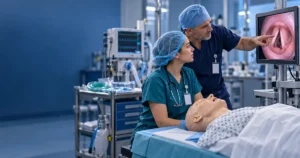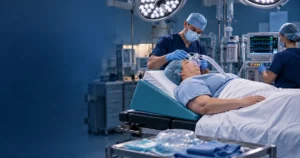
Video laryngoscope procurement for ambulatory surgery centers looks different from procurement for a large acute care hospital, and treating the two the same way leads to the wrong purchasing decision. ASCs operate on tighter budgets, smaller physical footprints, and faster decision timelines than most hospital systems. This guide explains what an ambulatory surgery center actually is, how fast the sector is growing in the United States, and what an ASC should specifically look for when choosing a video laryngoscope system.
What an ambulatory surgery center is
An ambulatory surgery center (ASC) is a freestanding facility that provides same-day surgical care. Patients arrive, undergo their procedure, and go home the same day without an overnight hospital stay. ASCs perform a wide range of procedures including cataract surgery, colonoscopies, knee arthroscopy, hernia repairs, and an increasing number of orthopaedic and cardiovascular procedures that were previously performed only in hospitals.
ASCs are distinct from hospital outpatient departments. An ASC is typically an independent facility, either physician-owned, corporately owned, or jointly owned with a hospital system, operating outside the traditional hospital campus and cost structure. This independence is central to why ASCs manage equipment procurement differently from hospitals.
How large the ASC sector is in the United States
The scale of the ASC sector has grown substantially and continues to expand. As of Q2 2025, there are 12,294 total ASCs operating nationwide, including 6,504 Medicare-certified facilities. Outpatient settings now host more than 80% of all U.S. surgeries, a dramatic shift from 1981, when hospital-owned facilities handled 93% of all surgical procedures.
The financial scale matches the facility count. ASC News’ Q4 2025 Insights Report tracked 10,494 ASCs nationwide, including 6,566 Medicare-certified facilities, with the Medicare-certified universe growing by roughly 1.5% in a single quarter. Procedure volumes at ASCs are forecast to climb 21% during the 2025 to 2035 window, and the ASC market overall generated $45 billion in revenue in 2024, projected to reach $57 billion by 2030.
Cardiovascular and orthopaedic procedures are the fastest-growing ASC specialties, both of which typically require general anaesthesia and airway management equipment. California leads the nation with the most surgery centers, and Maryland has the highest ASC density per capita, while Kentucky, West Virginia, and Vermont trail behind.
This growth is driven by cost. Patients who choose an ASC over a hospital outpatient department save an average of $684 per procedure, and ASCs collectively reduce Medicare expenditures by billions of dollars annually. As an aging U.S. population drives more surgical volume, and as payers and patients continue favouring lower-cost outpatient settings, ASC procedure volume, including procedures requiring general anaesthesia and airway management, will keep growing.
Why ASC procurement differs from hospital procurement
ASCs are not simply small hospitals. Their procurement priorities differ in ways that directly affect what video laryngoscope system makes sense.
Tighter capital budgets. Most ASCs operate as independent businesses with a defined annual capital budget, not a large hospital system’s equipment reserves. A video laryngoscope system with a lower total upfront cost, or one that can be phased in gradually, fits ASC budgeting far better than a system requiring a large single capital outlay.
Less physical storage space. ASCs are typically much smaller facilities than hospitals, often a handful of operating rooms rather than dozens. Storage space for equipment, consumables, and reprocessing infrastructure is limited. A compact monitor and a blade system that does not require a dedicated sterilisation suite is a practical necessity, not a preference.
No central sterile processing department in many cases. Many smaller and single-specialty ASCs do not operate a full central sterile processing department comparable to a hospital’s. This makes disposable blade options particularly relevant, since they remove the reprocessing infrastructure requirement entirely. For a full breakdown of when disposable blades make the most sense operationally, see our guide on single-use video laryngoscope blades.
Faster, less bureaucratic decision-making. Unlike a hospital, where a video laryngoscope purchase typically passes through a formal Value Analysis Committee involving multiple departments, an ASC purchasing decision is often made directly by the medical director, administrator, or a small ownership group. This means the sales cycle can be considerably shorter, but it also means the decision maker needs a complete, self-contained case for the purchase without the layered evidence review a hospital VAC provides.
Limited or no GPO affiliation. Many ASCs are not affiliated with the large GPOs that dominate acute care hospital purchasing. For context on how GPO and IDN dynamics shape hospital procurement differently, see our guide on how U.S. GPOs and IDNs shape video laryngoscope procurement decisions. ASCs more often purchase directly from manufacturers or distributors, which changes the sales approach required.
What ASCs should look for in a video laryngoscope system
Given these differences, the right video laryngoscope system for an ASC looks different from the system a 400-bed hospital would choose.
A compact, portable monitor. A large cart-based system designed for a big operating theatre does not suit an ASC’s smaller footprint. A compact handheld monitor that can be stored easily between cases and moved between rooms fits the ASC environment better.
Disposable blade options. Given the limited reprocessing infrastructure common in ASCs, disposable blades remove a significant operational burden. A system offering both disposable and reusable blades on the same monitor gives an ASC flexibility to choose per procedure without committing to a full reprocessing workflow.
A manageable total cost of ownership. ASCs weigh capital cost and per-procedure cost carefully, since margins in outpatient surgery are tighter than in hospital settings. A system with modest upfront cost and predictable per-blade pricing is easier for an ASC to justify than a system requiring significant infrastructure investment.
Simple training requirements. ASC staff often cover multiple roles, and formal in-house training programmes are less extensive than in large hospitals. A system that is intuitive to operate, with straightforward blade attachment and a simple interface, reduces the training burden on a small staff team.
Blade range covering common ASC specialties. With orthopaedic and cardiovascular procedures among the fastest-growing ASC specialty areas, a video laryngoscope system needs to cover the blade profiles and sizes relevant to routine general anaesthesia cases in these specialties, not just difficult airway scenarios.
What Astra-vue offers for ASC procurement
Astra-vue’s product line is well matched to the ASC procurement profile. The Mini Monitor is a compact, portable unit rather than a large cart-based system, fitting the smaller footprint most ASCs operate within. It runs both the reusable Ultra Blade range and the disposable Lite and Pro Blade ranges on the same universal monitor, giving an ASC the flexibility to use disposable blades where reprocessing infrastructure is limited, without needing separate equipment.
The Lite Blade range in particular suits ASCs that want the infection control benefit of single-use blades without the ongoing cost of a fully disposable system, since the reusable camera device stays in circulation while only the blade itself is discarded after each patient. For the full breakdown of this approach, see our guide on why a universal video laryngoscope monitor platform reduces hospital equipment complexity.
For ASC administrators and medical directors evaluating a video laryngoscope system, contact our team to discuss configuration options suited to your facility’s case mix and budget, or explore the full product line.
Frequently asked questions about video laryngoscopes for ambulatory surgery centers
How many ambulatory surgery centers are there in the United States?
As of Q2 2025, there are 12,294 total ASCs operating nationwide, including 6,504 Medicare-certified facilities. The sector continues to grow, with procedure volumes forecast to increase 21% between 2025 and 2035.
Why do ASCs need a different video laryngoscope setup than hospitals?
ASCs typically operate with tighter capital budgets, less physical storage space, limited or no central sterile processing infrastructure, and faster decision-making processes than hospitals. A video laryngoscope system that fits a large hospital’s operating theatre and reprocessing capacity does not necessarily suit a smaller ASC’s footprint and workflow.
Are disposable video laryngoscope blades better suited to ASCs than reusable blades?
For many ASCs, yes, though it depends on the facility’s specific infrastructure. ASCs without a dedicated central sterile processing department benefit from disposable blades, since they remove the reprocessing requirement entirely. ASCs with in-house reprocessing capability may still find reusable blades cost-effective for higher-volume procedures.
Do ASCs typically purchase through GPO contracts like hospitals?
Many ASCs are not affiliated with the large GPOs that dominate acute care hospital purchasing, and more often purchase directly from manufacturers or distributors. This generally makes the ASC sales and procurement process more direct than the GPO-mediated process common in large hospital systems.
What specialties are driving video laryngoscope demand growth in ASCs?
Cardiovascular and orthopaedic procedures are the fastest-growing ASC specialties, both of which frequently require general anaesthesia and airway management equipment. As these specialty areas continue shifting from hospitals to ASCs, demand for appropriately sized, cost-effective video laryngoscope systems in the ASC setting is expected to grow accordingly.