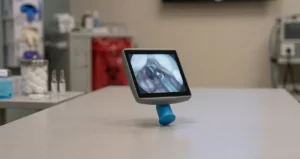
Single use video laryngoscope blades have moved from a niche infection control option to a standard procurement consideration for most departments. The question is no longer whether disposable blades have a role. It is which cases, settings, and departments benefit most from single-use, and where a reusable blade still makes better clinical and financial sense. This guide sets out the evidence, the trade-offs, and a practical framework for making that decision.
Why single-use blades are growing so quickly
The global laryngoscope blades and handles market was valued at USD 936 million in 2023 and is projected to reach USD 2,036.3 million by 2032, growing at a CAGR of 9.04% according to SNS Insider. The disposable segment is the primary driver of that growth, pushed by infection control mandates that intensified after the COVID-19 pandemic and have not eased since.
Two forces are converging to accelerate this shift. First, the DAS 2025 guidelines now recommend video laryngoscopy as first-line for all adult tracheal intubation, which means far more devices need to be in active circulation across a department at any given time. Second, the 2023 DEVICE trial published in the New England Journal of Medicine confirmed video laryngoscopy’s clear superiority in critically ill patients, accelerating adoption in exactly the settings- EDs and ICUs- where infection risk and patient turnover are highest.
More devices in circulation, used on more patients, in higher-risk settings, is precisely the environment where single-use blades solve a real operational problem.
What single-use actually solves
A single-use blade is used once, on one patient, and discarded. It eliminates cross-contamination risk because there is no reprocessing step where a contamination gap can occur. For departments with high patient turnover, this removes a bottleneck that reusable systems cannot avoid.
Reusable blades are semi-critical devices under CDC and AORN classification, requiring high-level disinfection at minimum between uses. That reprocessing cycle takes time, requires validated equipment and trained staff, and creates a point in the workflow where a blade is temporarily unavailable. In a department running high volumes or facing unpredictable surges, that unavailability is a genuine operational cost, not just a theoretical risk.
Single-use blades remove that step completely. A blade comes out of sterile packaging, is used once, and is discarded. There is no reprocessing queue, no risk of a validation failure, and no possibility that human error in the disinfection process leaves a blade non-compliant.
What single-use gives up
The trade-off is straightforward: single-use blades cost more per procedure than reusable blades amortised over their working life. For a department with stable, predictable volume and a reliable central sterile processing function, a reusable system can be the lower total cost option over time.
Disposable blades also depend on consistent supply. A department relying entirely on single-use blades is exposed to supply chain disruption in a way a reusable system is not, since a reusable blade already in the department’s inventory does not depend on the next delivery arriving on schedule.
Neither of these is a reason to avoid single-use blades altogether. They are reasons to choose deliberately rather than default to one system for the entire department.
A practical framework for deciding
Most departments do not need to choose exclusively between single-use and reusable. The more useful question is which settings within your department benefit most from each configuration.
Favour single-use for:
Emergency departments and other high-turnover settings, where reprocessing bottlenecks create real delays. Infection-sensitive patient populations, including immunocompromised patients and known or suspected transmissible infection cases. Prehospital and EMS settings, where reprocessing infrastructure does not exist at the point of use. Any setting where an unpredictable surge in volume could outstrip reprocessing capacity.
For more detail on why disposable blades matter specifically in the ED context, see our buyer’s guide to video laryngoscopes for emergency departments.
Favour reusable for:
Scheduled operating theatre lists with predictable, stable volume and a well-resourced central sterile processing department. Settings where cost per procedure is the dominant procurement factor and reprocessing infrastructure is already in place and validated. Departments with lower overall intubation volume, where the capital cost of reusable blades amortises more slowly but total spend remains lower than an equivalent single-use volume.
The case for running both. A department does not need to choose one system exclusively. Running single-use blades in the ED and ICU while maintaining reusable blades for scheduled theatre lists lets each setting use the configuration that fits its actual workflow. This is only practical, however, if both blade types run on the same monitor platform.
What to check in a single-use blade before buying
Not all disposable blades perform equally. A handful of features distinguish a well-engineered single-use blade from a basic one.
Anti-fog performance. A disposable blade goes straight from packaging to the patient’s airway with no pre-use warming step. Anti-fog coating is essential, not optional, since a fogged camera in the first seconds of an unplanned intubation defeats the purpose of the device.
Blade profile range. Confirm the disposable range covers both Macintosh and hyperangulated geometries, not just one. Departments need both available regardless of blade type, since neither geometry is superior for every patient. For guidance on when each geometry performs best, see our analysis of hyperangulated vs Macintosh blade selection.
Sterile packaging integrity. Confirm the blade is individually packaged and sealed, with clear labelling that supports quick identification of size and profile during a time-pressured procedure.
Monitor compatibility. A disposable blade that only works with a dedicated monitor forces a department to run separate equipment for single-use and reusable configurations. A blade that connects to the same universal monitor as the reusable range avoids that duplication.
The Astra-vue Lite Blade approach
Astra-vue’s positioning on this question is direct: a system that delivers the infection control benefits of single-use components without the ongoing expense of fully disposable systems.
The Lite Blade range is built around this principle. It pairs a reusable camera device with individually packaged, single-use transparent blades, giving departments the infection control benefit of a fresh blade on every patient while keeping the higher-cost camera component in circulation rather than discarded with every use.
The Lite Blade range includes:
- Macintosh profiles in sizes 1 through 4, covering the standard geometry most clinicians train on
- A dedicated Hyper 3 hyperangulated blade, giving departments access to both geometries in a single-use configuration
- Anti-fog coating on every blade, addressing the visibility risk specific to disposable devices used without a warming step
- Single-use transparent construction, individually packaged for straightforward identification and sterile handling
- Compatibility with the same universal monitor platform used across Astra-vue’s reusable range
This structure lets a department run single-use blades in high-turnover or infection-sensitive settings while keeping equipment and training consistent with the rest of its video laryngoscope inventory. To discuss which configuration fits your department’s specific case mix, contact our team or explore the full product line.
Frequently asked questions about single-use video laryngoscope blades
Are single-use video laryngoscope blades more expensive than reusable blades?
Per unit, yes. A single-use blade costs more than the equivalent per-procedure cost of a reusable blade amortised over its working life, once reprocessing labour and consumables are excluded. The comparison changes when you factor in reprocessing cost, reprocessing bottlenecks, and infection risk, particularly in high-turnover settings like the ED.
Which departments benefit most from single-use video laryngoscope blades?
Emergency departments, ICUs, and other high-turnover or infection-sensitive settings benefit most, since these environments face the greatest risk from reprocessing bottlenecks and cross-contamination. Prehospital and EMS settings also benefit, since reprocessing infrastructure does not exist at the point of use.
Can a department use both single-use and reusable video laryngoscope blades?
Yes, and many departments do exactly this. Running single-use blades in high-turnover settings and reusable blades on predictable scheduled lists lets each setting use the configuration that fits its workflow. This works best when both blade types connect to the same monitor platform, avoiding the need for separate equipment.
Why does anti-fog coating matter specifically for disposable blades?
A disposable blade goes directly from sterile packaging into use, without any pre-use warming step that some reusable systems allow. Anti-fog coating addresses the specific risk of camera fogging in the first seconds of use, which matters most in unplanned or urgent intubations where there is no time to troubleshoot a fogged view.
Does a single-use blade require the same monitor as a reusable blade?
Not necessarily, but it should for practical procurement reasons. A disposable blade that only works with its own dedicated monitor forces a department to maintain separate equipment for single-use and reusable configurations. A universal monitor platform that accepts both blade types avoids this duplication and keeps training consistent across the department.