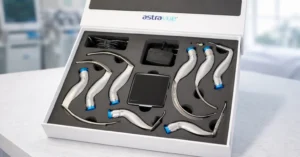
The European medical device market is entering a turning point, and one category is rising faster than the rest: video laryngoscopes. Hospitals across the European Union are moving away from traditional direct laryngoscopy and toward modern video-based airway systems that offer safer procedures, greater clinical confidence, and improved patient outcomes.
For EU medical distributors, this shift represents a rare moment where clinical demand, regulatory alignment, and market readiness converge. Video laryngoscopes are no longer premium optional tools. They are rapidly becoming the standard of care across emergency departments, intensive care units, operating rooms, and teaching hospitals.
Below is a deep look at why video laryngoscopes are emerging as one of the strongest growth opportunities in the EU medical device sector and why distributors who act now will be far ahead of competitors.
Clinical guidelines are driving adoption
European clinicians are aligning with updated international airway guidelines that strongly recommend video laryngoscopy for both routine and difficult airway cases.
The ASA Difficult Airway Guidelines highlight video-based intubation as a safer and more reliable option. Whenever guidelines change, procurement behaviour follows quickly.
EU hospitals are rewriting protocols to include video laryngoscopy, creating immediate opportunities for distributors who carry certified and reliable systems.
Emergency and ICU demand continues to rise in Europe
Across the European Union, hospitals are experiencing sustained pressure in emergency and critical care. Research from the European Respiratory Society shows a significant rise in respiratory-related hospital admissions across Europe, driven by seasonal outbreaks and chronic respiratory conditions.
Critical care units are facing similar challenges. A 2024 analysis of one hundred and forty-four ICUs in Europe found consistently high patient workload and noted that rising caseloads have a direct impact on patient outcomes and clinical decision-making.
Surgical activity is also increasing in many parts of Europe. Eurostat reports steady growth in several major surgical procedures across EU member states, driven by population ageing and expanding healthcare capacity. As surgical volumes rise, hospitals require more consistent and reliable airway management tools inside operating rooms.
These combined pressures mean clinicians must intubate more patients, often under time-sensitive and high-stress conditions. In this environment, a video laryngoscope gives clinicians a clear and shared view of the airway, supporting:
- Faster and more informed decision-making
- Higher first pass success rates
- Fewer complications during difficult intubations
- More stable performance in emergency and ICU settings
As hospitals work to improve safety and efficiency during airway management, this trend continues to drive strong demand for certified and reliable video laryngoscope systems across the EU. This shift also creates a significant opportunity for medical distributors who can offer modern and dependable solutions.
Infection control expectations have changed across Europe
In recent years, infection prevention has become one of the highest priorities for hospitals across the European Union. This shift began during the global pandemic, but it has continued due to broader awareness of cross-contamination risks, hospital-acquired infections, and the need for cleaner clinical workflows.
Strong evidence supports this change. The World Health Organisation continues to emphasise that airborne and contact-based risks remain a major concern in clinical environments and recommends strict infection prevention and control strategies for all airway-related procedures.
- Hospitals within the EU have responded to these recommendations by updating procurement guidelines. Many are now prioritising devices that:
- Reduce surface contamination
- Minimise cleaning and reprocessing errors
- Lower the risk of pathogen transmission
- Support faster room turnover in critical units
These updates are not theoretical. A large European survey published in 2023 found that infection prevention teams across multiple EU member states increased their focus on single patient use medical devices due to the clear reduction in cross-contamination risk they provide.
Studies across several EU countries also highlight that reprocessing failures remain one of the most common causes of hospital-acquired infections. When airway devices are not cleaned correctly, the risk increases dramatically. This is one reason why hospitals are moving toward single-use or partially disposable systems.
Video laryngoscope systems with single-use blades align perfectly with these infection control requirements. By eliminating the need for complex reprocessing, they reduce the chance of contamination and help hospitals maintain safe and predictable workflows in operating rooms, emergency departments, and intensive care units.
These infection control priorities are now accelerating the adoption of disposable and hybrid video laryngoscopy systems across Europe. Hospitals want airway devices that are not only clinically effective but also safe, easy to manage, and fully aligned with modern patient safety standards.
The limitations of older direct laryngoscopes are well documented
Many hospitals still rely on traditional direct laryngoscopes, but clinical evidence increasingly shows that these older tools have important limitations. Direct laryngoscopy depends on aligning the oral, pharyngeal, and laryngeal axes, which is often difficult in real-life airway scenarios.
A major Cochrane Review comparing video and direct laryngoscopy found that video laryngoscopes provide significantly better visualisation of the airway and reduce failed intubation attempts in difficult airways.
First pass success is also higher with video laryngoscopy. A study published in JAMA demonstrated that clinicians achieved more first-attempt successes with video laryngoscopes during emergency intubation.
The risks of depending on direct laryngoscopy become even more pronounced during emergencies. Research from Annals of Emergency Medicine shows that repeated direct laryngoscopy attempts significantly increase complications such as hypoxemia, airway trauma, and aspiration.
Training is also more challenging with traditional tools. A study from the British Journal of Anaesthesia highlights that video laryngoscopy allows supervisors to see the same view as the intubator, improving safety, feedback, and clinical teaching.
This growing body of evidence is driving many hospitals to shift away from older direct laryngoscope devices and upgrade to video based systems that offer a clearer view of the airway, higher success rates, improved training, and more predictable performance during critical situations.
The EU market rewards innovation and certification
European procurement teams place a high value on:
- Proven clinical performance
- CE certification
- MDR compliance
- Long-term reliability
- Training support
- High-quality imaging and illumination
This aligns perfectly with AstraVue’s strengths.
Our systems offer:
- FDA and CE certification
- MDR compliance
- ISO 13485 manufacturing
- Patented design for secure blade connection
- High-performance imaging for improved accuracy
- These factors matter greatly in EU distributor negotiations.
Teaching hospitals in Europe prefer video-based training
Teaching hospitals and university medical centres across Europe increasingly use video laryngoscopes as their primary tool for airway training. The European Resuscitation Council recommends video laryngoscopy for in-hospital airway management because it provides a clearer view of the glottis and allows supervisors and trainees to see the same airway image at the same time.
This shared visualisation is a key advantage in European training environments. The British Journal of Anaesthesia notes that video laryngoscopy improves learning by allowing instructors to guide trainees in real time and intervene before errors occur. European airway training organisations reinforce this trend. The European Airway Management Society incorporates video laryngoscopy into many of its teaching programs, acknowledging its value in demonstrating airway anatomy and teaching safe intubation techniques.
As medical students, residents, and new clinicians in Europe learn airway management with video laryngoscopes, their expectations shape purchasing decisions in hospitals. When teaching hospitals adopt video-based training, surrounding regional and private hospitals often follow, ensuring the same tools are available for day-to-day clinical work. The growing adoption of video laryngoscopy is closely tied to improving first-pass success in intubation and reducing airway-related complications.
For distributors, this creates a consistent and long-term opportunity. Training adoption drives clinical adoption, and clinical adoption drives new purchases and repeat orders across the EU healthcare ecosystem.
Distributors gain a powerful advantage
EU medical distributors who build a strong airway portfolio now will gain:
- A fast-growing product category
- Long-term resupply volumes
- A competitive edge against suppliers focused on outdated tools
- Increased influence during hospital upgrades
- A more attractive solution set for public and private tenders
Most importantly, distributors who partner with certified manufacturers early can secure long-term market share.
AstraVue supports distributors with:
- Clinical demonstration content
- Training materials
- Consistent supply
- Marketing support
- Attractive pricing structures
The rise of video laryngoscopes in Europe is not a small trend. It is a major transformation in airway management. Clinical guidelines, infection control priorities, surgical growth, and ICU demand all point in the same direction.
For EU distributors, this is the first time in years that an airway device category has aligned so clearly with market demand. The opportunity is wide open, and the distributors who act now will become the long-term leaders of this space.