The 2022 ASA Practice Guidelines for Management of the Difficult Airway represent the most significant update to U.S. airway management standards in over a decade. For anesthesiologists, CRNAs, and department leads, one recommendation stands out: the guidelines explicitly support video-assisted laryngoscopy as an initial approach to intubation. This is not a minor revision. It changes how departments should equip their operating rooms, train their clinicians, and justify their procurement decisions.
This post breaks down what the ASA 2022 guidelines say about video laryngoscopy, how they differ from the previous version, and what U.S. anesthesiology departments must do to align with the current standard.
What the ASA 2022 guidelines say about video laryngoscopy
The ASA 2022 guidelines make a clear, evidence-backed statement on video-assisted laryngoscopy. The guidelines list it as one of the primary noninvasive interventions for managing both anticipated and unanticipated difficult airways. More significantly, they explicitly support its use as an initial approach to intubation. It is no longer positioned as a rescue tool after direct laryngoscopy fails.
The supporting evidence the task force cited is substantial. Meta-analyses of randomised controlled trials comparing video-assisted laryngoscopy with direct laryngoscopy in patients with predicted difficult airways reported improved laryngeal views, a higher frequency of successful intubations, a higher frequency of first attempt intubations, and fewer intubation maneuvers with video-assisted laryngoscopy.
This is the ASA’s own language, drawn directly from the published guidelines. It is a category-A level endorsement of video laryngoscopy based on the highest quality clinical evidence available.
How the ASA 2022 guidelines differ from the previous version
The previous ASA difficult airway guidelines, published in 2013, acknowledged video laryngoscopy but treated it primarily as an alternative technique within a broader toolkit. The 2022 update elevates its status considerably.
The new 2022 guidelines include an emphasis on limiting attempts at laryngoscopy and encouraging an early call for help, and confirming gas exchange by the detection of CO2 independent of the device used. These changes reflect a broader shift: the 2022 guidelines focus on engineering success from the first attempt, not managing the fallout from repeated failures.
A new decision tree has been added to the ASA algorithm to help the anesthesiologist choose between pathways. The decision tree guides the anesthesiologist through basic assessments in a rational order. It starts by independently considering risk for intubation difficulty with direct or video laryngoscopy, risk for ventilation difficulty, risk for aspiration and oxyhemoglobin desaturation, and the difficulty of performing a rescue invasive airway.
This structural change is significant. The 2022 algorithm builds in a deliberate, step-by-step risk assessment before any intubation attempt. Video laryngoscopy features at the entry point of that assessment, not as an afterthought at the end of a failed sequence.
Three additional changes in the 2022 update reflect the same first-attempt success philosophy. First, the guidelines now explicitly include videolaryngoscopy as an awake intubation technique alongside flexible bronchoscopy and direct laryngoscopy. Second, preoxygenation standards were strengthened: the guidelines recommend low- or high-flow nasal cannula with the head in an elevated position throughout the procedure, and noninvasive ventilation during preoxygenation. Third, the guidelines add dedicated pediatric and extubation algorithms, both of which reference video laryngoscopy as a key tool.
The ASA algorithm: how video laryngoscopy fits in
The ASA 2022 Difficult Airway Algorithm for adult patients runs two parallel tracks: the anticipated difficult airway pathway and the unanticipated difficult airway pathway. Video laryngoscopy has a defined role in both.
For the anticipated difficult airway, the algorithm guides the anesthesiologist toward awake intubation when specific risk factors are present. Awake intubation techniques listed include flexible bronchoscope, videolaryngoscopy, direct laryngoscopy, combined techniques, and retrograde wire-aided intubation. Video laryngoscopy now sits at the same level as flexible bronchoscopy as a first-choice awake technique.
For the unanticipated difficult airway, the algorithm moves through a sequence of escalating interventions. Alternative difficult intubation approaches include video-assisted laryngoscopy, alternative laryngoscope blades, combined techniques, intubating supraglottic airway with or without flexible bronchoscopic guidance, flexible bronchoscopy, introducer, and lighted stylet or lightwand. Video-assisted laryngoscopy leads this list. That ordering is deliberate.
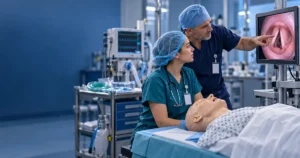
The 2022 guidelines emphasise a systematic approach to airway management, conducted quickly and efficiently. Video laryngoscopy supports that goal because its shared screen gives the whole team situational awareness during the attempt, something direct laryngoscopy cannot provide.
ASA 2022 versus DAS 2025: where the two guidelines align and diverge
U.S. anesthesiologists should understand how the ASA 2022 guidelines compare to the DAS 2025 guidelines, published by the Difficult Airway Society in November 2025. Both documents strongly support video laryngoscopy. Their precise language differs.
The DAS 2025 guidelines make an explicit first-line recommendation: a videolaryngoscope should be used first line for all adult tracheal intubation whenever possible. The ASA 2022 guidelines stop short of that language. They support video-assisted laryngoscopy as an initial approach and list it first among alternative intubation techniques, but they do not use “first line” or “default” language.
A strong and innovative message from the ever-growing evidence is the new role of the videolaryngoscope as a first-choice device in patients with at least two risk factors for difficult intubation, and as the second attempt device if the first attempt with a standard laryngoscope has failed.
The direction of travel is the same in both guidelines. The ASA guidelines give anesthesiologists more discretion based on their experience, available resources, and clinical context. The airway manager’s choice of airway strategy and techniques should be based on their previous experience, available resources including equipment, availability and competency of help, and the context in which airway management will occur.
For U.S. departments, this means the ASA guidelines do not mandate video laryngoscopy for every case. They strongly recommend it as an initial approach for difficult airways and explicitly endorse its use across the entire difficult airway algorithm. Given that the 2024 JAMA trial and the Cochrane data will likely influence the next ASA revision, the gap between ASA 2022 and DAS 2025 language is likely to narrow.
What the clinical evidence behind the ASA recommendation shows
The ASA task force based its video laryngoscopy recommendations on a rigorous review of the clinical literature. The evidence is consistent across studies.
The Cochrane meta-analysis by Hansel et al. (Cochrane Database Syst Rev, 2022;4:CD011136) analysed more than 200 randomised controlled trials covering over 26,000 patients. It concluded that video laryngoscopes reduce failed intubation rates and raise first-attempt success across all patient groups and operator experience levels.
The 2024 JAMA cluster randomised trial by Ruetzler et al. covered 8,429 procedures across 16 operating rooms. Hyperangulated video laryngoscopy cut the proportion of patients needing more than one intubation attempt from 7.6% to 1.7%. That reduction means fewer complications, less airway trauma, and shorter ICU stays per patient episode.
Together, these studies answer the objections that kept many U.S. departments from adopting video laryngoscopy as a routine first-line tool. The benefits extend across all operator experience levels. The device does not slow down routine cases. And its performance advantage is largest in the cases that matter most. Unanticipated difficult airways are where a failed first attempt carries the highest clinical consequences.
For a deeper look at why imaging quality determines how much of that clinical advantage your department actually captures in practice, read Why Imaging Quality Matters in Intubation Success.
What ASA 2022 means for your department operationally
The ASA 2022 guidelines carry direct operational implications for U.S. anesthesiology departments. Three areas require immediate attention.
Equipment access
The ASA guidelines list video-assisted laryngoscopy as the leading alternative intubation approach in both the anticipated and unanticipated difficult airway pathways. A department where video laryngoscopes are locked in a difficult airway cart and not immediately accessible at every anaesthetic location is not set up to act on these guidelines.
The recently published 2022 ASA guidelines for managing the difficult airway are a significant change from previous guidelines. These changes are meant to assist clinicians in decision-making. As airway management equipment improves, human factor concerns, team-based performance, and cognitive errors remain hurdles to safe airway management.
Equipment access directly addresses the human factors concern. A video laryngoscope at the head of the table removes the decision latency that comes with retrieving a device from a cart. See our guide on reusable vs disposable vs hybrid video laryngoscope configurations for a breakdown of which system works best for different department volumes and settings.
Training and competency
The ASA 2022 guidelines explicitly tie technique choice to the clinician’s previous experience. A department that owns video laryngoscopes but has not trained all grade levels in both Macintosh-profile and hyperangulated technique is not extracting the clinical benefit that the guidelines are based on.
For a breakdown of when hyperangulated blades outperform Macintosh-profile designs and when the reverse applies, see our analysis of hyperangulated vs Macintosh blade selection in difficult airways.
Procurement justification
For department leads who need to secure budget for additional units, the ASA 2022 guidelines provide a strong clinical evidence anchor. The task force meta-analysis showed improved laryngeal views, higher first attempt success rates, and fewer intubation maneuvers. This meets the evidence threshold that most U.S. hospital Value Analysis Committees require for capital equipment approval.
Build the procurement submission around four elements: the ASA 2022 guideline recommendation, the Cochrane meta-analysis, the 2024 JAMA trial data, and a total cost of ownership analysis showing the financial cost of failed and repeated intubation attempts. Our video laryngoscope buying guide for U.S. hospitals walks through how to structure that submission in detail.
How ASA 2022 applies to CRNAs and advanced practice providers
The ASA guidelines apply to the full scope of U.S. airway management practice, not only to physician anesthesiologists. Certified Registered Nurse Anesthetists (CRNAs) perform the majority of anesthesia cases in many U.S. hospitals, particularly in rural and community settings. The ASA 2022 guidelines are the clinical evidence standard that governs difficult airway management across all provider types.
For CRNAs, the video laryngoscopy recommendation carries additional weight. Evidence consistently shows that video laryngoscopy improves first-attempt success rates across all operator experience levels. In solo-provider settings where calling for immediate physician backup is not always feasible, a device that raises first-attempt success rates directly reduces the risk of progressing to a can-not-intubate scenario.
What your department should do now
Based on the ASA 2022 guidelines and the supporting clinical evidence, the following four steps give U.S. departments a clear path to alignment.
Step 1: Audit video laryngoscope availability. Count units against your peak simultaneous caseload. Confirm a device is immediately accessible at every anaesthetic location, not stored in a central difficult airway kit.
Step 2: Review blade type coverage. The ASA guidelines support video-assisted laryngoscopy broadly without mandating a specific blade geometry. Confirm your department has both Macintosh-profile and hyperangulated blades available, and that clinicians hold specific technique training for each.
Step 3: Update your departmental difficult airway algorithm. Align your posted algorithm with the ASA 2022 structure. Video-assisted laryngoscopy should appear as the leading alternative intubation approach in both the anticipated and unanticipated pathways, not as a late-stage rescue option.
Step 4: Prepare your procurement submission. Use the ASA 2022 guidelines as the clinical anchor. Add the Cochrane meta-analysis and the 2024 JAMA trial. Frame the patient safety case around first-attempt success rates and the cost of failed intubation episodes.
Astra-vue offers video laryngoscope systems in reusable, single-use, and hybrid configurations on a single universal monitor platform. The system is designed to support first-line adoption across multiple departments and operator levels. For product specifications and U.S. availability, contact our team or explore the full product line.
Frequently asked questions about ASA guidelines and video laryngoscopy
What do the ASA 2022 guidelines say about video laryngoscopy?
The ASA 2022 Practice Guidelines explicitly support video-assisted laryngoscopy as an initial approach to intubation and list it as the leading noninvasive alternative intubation technique in both the anticipated and unanticipated difficult airway pathways. The task force cited meta-analyses of randomized controlled trials showing improved laryngeal views, higher first-attempt success rates, and fewer intubation maneuvers with video laryngoscopy compared to direct laryngoscopy.
Do the ASA 2022 guidelines make video laryngoscopy mandatory?
No. The guidelines support video-assisted laryngoscopy strongly and recommend it as an initial approach for difficult airways. However, they leave technique choice to the clinician’s judgement, based on their experience, available equipment, and the clinical context. The 2022 guidelines give departments strong clinical and medicolegal justification to standardise on video laryngoscopy without mandating it outright.
How do the ASA 2022 guidelines differ from the DAS 2025 guidelines?
The DAS 2025 guidelines make an explicit first-line recommendation: a videolaryngoscope should be used first line for all adult tracheal intubation whenever possible. The ASA 2022 guidelines support it as an initial approach for difficult airways and list it first among alternative intubation techniques, but stop short of first-line language. Both documents are strongly aligned on the evidence base and the direction of travel.
Do the ASA guidelines apply to CRNAs as well as physician anesthesiologists?
Yes. The ASA 2022 guidelines govern difficult airway management standards across all U.S. airway management practices. CRNAs, anesthesiologist assistants, and physician anesthesiologists all practice within the clinical standard these guidelines define.
How should a department use the ASA 2022 guidelines to justify video laryngoscope procurement?
The ASA task force meta-analysis finding, which showed improved laryngeal views, higher first-attempt success, and fewer intubation maneuvers, meets the evidence threshold most U.S. hospital Value Analysis Committees require. Combine the ASA 2022 recommendation with the Cochrane 2022 meta-analysis, the 2024 JAMA trial data, and a total cost of ownership analysis that includes the financial cost of failed intubation episodes.