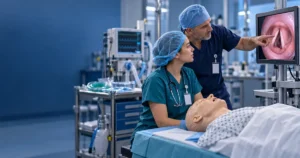
Video laryngoscopy in obese patients has become a common first choice in operating rooms, emergency departments, and ICUs. Obesity changes airway anatomy and, more importantly, shortens the time a patient can tolerate apnea. As a result, every failed attempt carries a higher risk of hypoxemia. This guide reviews what the evidence shows, how positioning and preoxygenation fit in, and which blades work best.
This article is educational and does not replace local protocols or supervised training.
Why obesity makes intubation harder
Obesity affects the airway in two main ways.
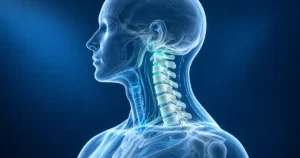
Anatomy. Extra tissue in the neck, tongue, and pharynx can make the glottis harder to see. In addition, a large chest can get in the way of the laryngoscope handle.
Physiology. Obese patients have a smaller functional residual capacity, so their oxygen reserve is lower. They also use oxygen faster. Therefore, saturation can fall within a short time after apnea begins.
Interestingly, anatomy alone may not predict failure as strongly as many clinicians expect. Instead, it is the speed of desaturation that turns a slow intubation into a dangerous one.
What the evidence says about video laryngoscopy in obese patients
Hypoxemia is the main risk
A 2025 secondary analysis of the INTUBE study in Critical Care looked at 2,946 critically ill patients, of whom 639 were obese. Severe hypoxemia occurred in 12.1% of obese patients, compared with 8.6% of non obese patients.
The authors found that first pass failure and worse baseline oxygenation were key drivers of that hypoxemia. In other words, getting the tube in on the first attempt matters even more in obesity.
First attempt success improves
An editorial in Critical Care discussing these findings cited a meta-analysis of 18 randomized trials with 1,594 obese patients. In that analysis, video laryngoscopy improved first-attempt success compared with direct laryngoscopy. The editorial also noted that the Canadian Airway Focus Group recommended video laryngoscopy as the first choice for all intubations in 2021.
The evidence is not uniform
Not every analysis agrees. A 2025 meta analysis in Medicina Intensiva focused on obese critically ill patients and found no significant difference between video and direct laryngoscopy across 15 studies.
That nuance matters. Elective surgical trials show a clearer benefit, while ICU data are more mixed. Even so, no major analysis suggests that video laryngoscopy performs worse. For a wider review, see our comparison of video laryngoscope vs direct laryngoscope.
Positioning: The ramped position
Positioning may matter as much as the device. In obese patients, the standard sniffing position often fails to align the airway.
The ramped position solves this. Blankets or a purpose-built ramp raise the upper back, shoulders, and head until the ear canal sits level with the sternal notch. This position:
- improves the view during laryngoscopy,
- helps mask ventilation,
- increases oxygen reserve before induction,
- makes breathing easier for the awake patient.
A slight head-up tilt of the whole bed can add further benefit. For instance, many teams combine ramping with a reverse Trendelenburg tilt during preoxygenation.
Preoxygenation for obese patients
Good preoxygenation buys time. The PREOXI trial found that noninvasive ventilation reduced hypoxemia from 18.5% to 9.1% compared with an oxygen mask in critically ill adults.
For obese patients, positive pressure helps keep small airways open. Consequently, many teams use noninvasive ventilation or high flow nasal oxygen before induction.
Apneic oxygenation through nasal cannula during laryngoscopy can also extend safe apnea time. Similarly, a well-fitted mask and two-handed technique help if mask ventilation becomes necessary.
Blade choice for video laryngoscopy in obese patients
Both main blade types can work well.
Macintosh style video blades suit most obese patients with good positioning. They allow a familiar technique and a direct view if secretions cover the camera.
Hyperangulated blades help when the larynx sits high and anterior or when neck movement is limited. However, tube delivery needs a stylet shaped to the blade curve.
Handle access is a practical concern. A large chest can block the handle during insertion. In that case, inserting the blade from the side of the mouth and rotating it to the midline can help.
Our guide to hyperangulated vs Macintosh blades for difficult airways explains the trade-offs in more detail.
A practical approach to the obese airway
Most teams follow a similar plan.
- Assess early. Look for predictors such as a short neck, large neck circumference, or sleep apnea history.
- Ramp the patient. Align the ear with the sternal notch before induction.
- Preoxygenate with positive pressure when suitable.
- Add apneic oxygenation with nasal cannula.
- Use a video laryngoscope first. This raises the chance of first-pass success.
- Have a bougie and stylet ready. Both help when the view is partial.
- Prepare rescue options. Keep a second-generation supraglottic airway and a front-of-neck access kit nearby.
- Plan for extubation. Obese patients also face risk after surgery, so extubation needs the same care.
Front of neck access deserves special attention. Since neck landmarks can be hard to feel, some clinicians mark the cricothyroid membrane with ultrasound before induction.
Video laryngoscopy in obese patients outside the operating room
The ICU and emergency department bring extra challenges. Obese patients there are often already hypoxemic, unstable or unable to lie flat.
For that reason, video laryngoscopy in obese patients outside theatre should come with a full bundle: positioning, preoxygenation, hemodynamic preparation, and an experienced operator. Our guides to the video laryngoscope ICU setting and rapid sequence intubation with a video laryngoscope cover these steps.
Equipment planning for video laryngoscopy in obese patients
Departments that care for many obese patients, such as bariatric surgery programs, should plan equipment around them. Otherwise, teams end up improvising positioning and rescue kits in the middle of a case.
Useful items include:
- a purpose-built ramp or wedge that stays with the airway trolley,
- beds and tables rated for the patient’s weight,
- large blood pressure cuffs and secure monitoring leads,
- noninvasive ventilation masks in several sizes,
- second-generation supraglottic airways in large adult sizes,
- a bougie and a stylet shaped for hyperangulated blades,
- ultrasound for airway landmarks when available.
Staffing matters as well. Moving and ramping a heavy patient safely takes several people, so teams should gather help before induction rather than after a problem starts.
Finally, consistency helps. When the same video laryngoscope platform runs across theatre, ICU and the emergency department, clinicians do not need to adapt to a new device in a stressful case. Our article on a universal video laryngoscope monitor platform explains this approach.
How Astra-vue supports bariatric airway care
Astra-vue offers one monitor platform with blades for different airway shapes. Reusable Ultra Blades include Macintosh sizes 1 to 4 and hyperangulated and channeled hyperangulated designs. For single-use workflows, the Pro Blade comes in Macintosh sizes 2 to 4, and the anti-fog Lite Blade comes in Macintosh sizes 1 to 4 plus a hyperangulated size 3.
The Mini Monitor has a 4-inch touchscreen, a 720p HD camera, and about 85 minutes of battery life. It records video to 16GB of storage for review and teaching. The system is FDA registered and listed, CE marked under MDR, and built under ISO 13485. Visit our products page or contact our team.
Video laryngoscopy in obese patients FAQs
Is video laryngoscopy better for obese patients?
Pooled trials in obese patients show higher first-attempt success with video laryngoscopy. However, data in obese critically ill patients are more mixed.
What is the best position for intubating an obese patient?
The ramped position, with the ear canal level with the sternal notch, usually gives the best view and improves preoxygenation.
Why do obese patients desaturate so fast?
They have a smaller oxygen reserve and use oxygen faster. As a result, saturation can fall soon after apnea starts.
Which blade works best in obesity?
Macintosh-style video blades suit most cases with good positioning. Hyperangulated blades help when the larynx sits high or neck movement is limited.
How can teams reduce hypoxemia during intubation?
Ramp the patient, preoxygenate with positive pressure, add apneic oxygenation, and aim for success on the first attempt.