A universal video laryngoscope monitor platform is one of the most significant but least discussed procurement decisions a hospital airway management team can make. Most departments focus on blade type when evaluating video laryngoscopes. Procurement teams scrutinise the monitor platform far less. That is a mistake. The monitor determines which blades a department can use, how many units it needs to stock, how training is structured, and what the real capital cost of first-line video laryngoscopy adoption looks like across multiple departments simultaneously.
This post explains what a universal video laryngoscope monitor platform is, why it matters operationally, and what procurement teams should look for before committing to a system.
What a universal video laryngoscope monitor platform is
A universal video laryngoscope monitor platform is a single monitor unit that accepts multiple blade types across different clinical configurations. Rather than requiring a separate monitor for reusable blades, another for disposable blades, and potentially a third for a channeled hyperangulated design, a universal platform runs all blade types from one monitor unit.
The clinical case for video laryngoscopy is now settled. The DAS 2025 guidelines make it the explicit first-line recommendation for all adult tracheal intubation. The ASA 2022 guidelines list video-assisted laryngoscopy as the leading alternative intubation approach. This applies to both anticipated and unanticipated difficult airways. The 2024 JAMA trial by Ruetzler et al. covered 8,429 procedures. It showed hyperangulated video laryngoscopy reduced multi-attempt intubation rates from 7.6% to 1.7%.
Acting on these guidelines requires equipment to be present and accessible. For most departments, that means significantly increasing the number of video laryngoscope units in service. The monitor platform choice determines whether that increase is affordable.
Why blade type compatibility matters more than most procurement teams realise
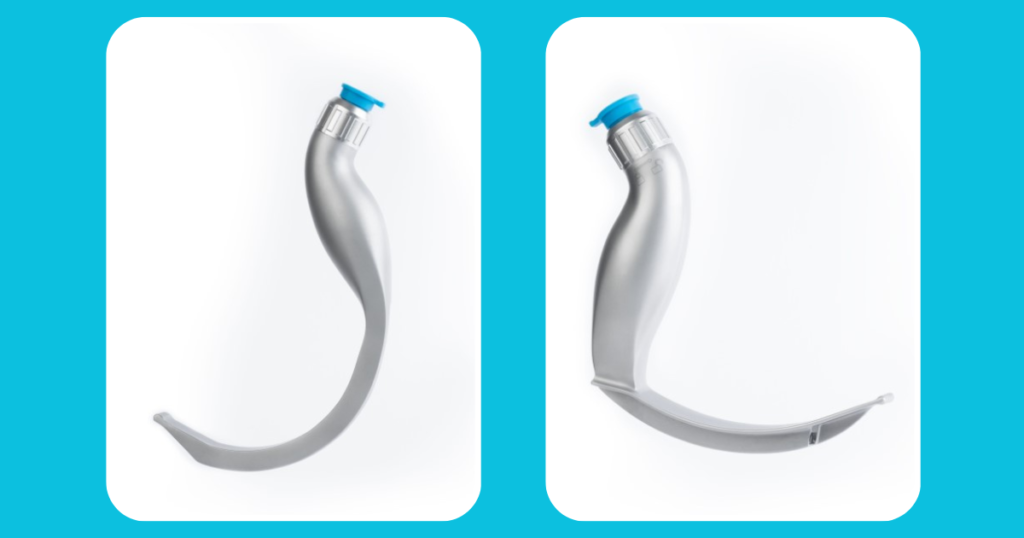
No single blade type serves every clinical situation equally well. Macintosh-profile blades mirror the geometry most clinicians trained on and allow both direct and video-assisted visualisation. Hyperangulated blades deliver superior glottic views in difficult airways but require a stylet and different insertion technique. Channeled hyperangulated blades guide the endotracheal tube directly to the glottis and are particularly valuable for less experienced operators or in high-stress emergencies. Miller blades are straight-profile designs used primarily in neonatal and paediatric intubation.
The DAS 2025 guidelines explicitly state that no strong evidence currently supports one blade geometry over another and that departments should have access to both Macintosh-profile and hyperangulated designs. The ASA 2022 guidelines similarly endorse multiple approaches without mandating a single geometry.
A department that commits to a monitor platform accepting only one blade type locks itself into that geometry. If the clinical evidence or departmental case mix later requires a different blade design, it requires buying a new monitor platform entirely. A universal platform that accepts all blade types on the same monitor eliminates that lock-in.
For a full clinical breakdown of when each blade geometry performs best, see our guide on hyperangulated vs Macintosh blade selection in difficult airways.
The capital expenditure argument for a universal monitor platform
The financial case for a universal video laryngoscope monitor platform becomes clear when you model the capital cost of first-line adoption across a multi-department hospital.
Consider a hospital with three operating theatres, an emergency department, an ICU, and a maternity unit. First-line video laryngoscopy under DAS 2025 means a device must be immediately accessible in every anaesthetic location. If reusable blades are used in the operating theatres, disposable blades in the ED for infection control reasons, and paediatric or neonatal blades in the maternity unit, a non-universal monitor platform requires three separate monitor types. Each monitor type carries its own capital cost, its own training requirement, its own servicing contract, and its own spare parts inventory.
A universal platform that accepts reusable, disposable, and paediatric blades on a single monitor unit reduces that to one monitor type across all locations. The capital saving on monitors is direct and immediate. The operational saving on training, inventory management, and servicing accumulates over the contract period.
According to SNS Insider’s laryngoscope blades and handles market report, the global laryngoscope blades and handles market was valued at USD 936 million in 2023 and is projected to reach USD 2,036.3 million by 2032, growing at a CAGR of 9.04%. The disposable segment is growing fastest, driven by infection control mandates most acute in ED and ICU settings. Many departments are moving toward mixed environments where disposable blades are used in high-risk or high-turnover settings and reusable blades are used elsewhere. A universal monitor platform is the only configuration that serves both use cases without capital duplication.
For a broader framework for evaluating total cost of ownership across blade types and monitor configurations, see our video laryngoscope buying guide for U.S. hospitals.
How a universal video laryngoscope monitor platform supports training
A universal video laryngoscope monitor platform also improves training outcomes. The 2025 narrative review by Kelly et al. published in Anaesthesia found that video laryngoscopy improved direct laryngoscopy training outcomes rather than degrading them. The shared screen of a video laryngoscope blade allows trainers to point out anatomical landmarks in real time during intubation, making both video and direct technique teaching more effective.
A universal monitor platform amplifies this training benefit. When every blade type in a department runs on the same monitor, trainees learn one interface rather than multiple systems. Trainers can switch between blade types for different teaching scenarios without changing equipment. Simulation sessions can use the same monitor unit as clinical practice. Documentation from photo and video capture is consistent across all blade types and all clinical settings.
This matters particularly for departments that train across multiple clinical environments. A universal platform means the monitor a trainee uses in the operating theatre is identical to the one they will encounter in the emergency department or ICU. Familiarity with one device transfers directly to every other setting.
What to look for in a universal video laryngoscope monitor platform
Not all video laryngoscope systems described as universal deliver genuine cross-blade compatibility. Procurement teams should verify four things before accepting a universal platform claim.
Confirmed blade compatibility list. Ask the manufacturer to provide a complete list of every blade type and size that runs on the monitor. Confirm that list includes all configurations your department will need: adult Macintosh, hyperangulated, channeled hyperangulated, and if relevant, neonatal and paediatric sizes.
Single connector standard. A genuinely universal platform uses one connector standard across all blade types. If different blade types require adapters or different connector ports on the monitor, that is not a true universal platform.
Battery life for portable use. A universal monitor used across multiple departments including the ED and prehospital settings must sustain adequate battery life for continuous portable use. Verify battery life under continuous operation, not standby specifications.
Durability rating. A monitor that moves between departments, including the ED and ICU, encounters cleaning chemicals, physical handling, and moisture exposure daily. An IP54 rating or equivalent is the appropriate standard for a monitor used across these environments.
How the Astra-vue universal video laryngoscope monitor platform works
Astra-vue’s Mini Monitor (GS-VL-MN) is a universal platform designed to meet the specific requirements that first-line video laryngoscopy adoption places on hospital equipment infrastructure.
The Mini Monitor accepts all Astra-vue Ultra Blade reusable configurations: Channeled Hyperangulated (sizes 1 to 4), Hyperangulated (sizes 1 to 4), Macintosh (sizes 1 to 4), and Miller (sizes 000, 00, 0, and 1 for neonatal and paediatric use). It also accepts both disposable blade configurations: the Pro Blade with integrated camera technology (sizes 2 to 4 in sterile and non-sterile packaging) and the Lite Blade paired with the reusable Lite Camera Device (sizes 1 to 4).
Every blade type connects to the same monitor via a single consistent interface. There are no adapters. There is no secondary monitor required for disposable blades.
The monitor itself is a compact 4-inch swivel display with up to 85 minutes of continuous battery life and a 120-minute charging time. It includes photo and video capture with 16GB of onboard storage, a mini HDMI port for connection to external displays for training or team situational awareness, and USB-C charging and file transfer. It carries an IP54 rating, protecting against dust and water splashes in ED and clinical ward environments.
Astra-vue’s system is certified to FDA, CE, MDR, and ISO 13485 standards, built on Goldstar Medical’s 40-year manufacturing heritage.
For departments evaluating Astra-vue for first-line adoption across multiple clinical areas, the universal monitor platform means one capital investment covers every blade configuration your department will need. To request a product evaluation or discuss procurement terms, contact our team or explore the full product line.
Frequently asked questions about universal video laryngoscope monitor platforms
What is a universal video laryngoscope monitor platform?
A universal video laryngoscope monitor platform is a single monitor unit that accepts multiple blade types including reusable, disposable, and hybrid configurations across different clinical settings. It allows a hospital to standardise on one monitor across all departments while using the blade type that suits each clinical environment, without buying separate monitors for each configuration.
Why does blade compatibility matter for hospital procurement?
The DAS 2025 guidelines and ASA 2022 guidelines both endorse multiple blade geometries for different clinical situations. A monitor that only accepts one blade type locks a department into a single geometry. Clinical evidence and case mix may require different designs across departments. A universal platform removes that constraint without duplicating capital expenditure.
How does a universal monitor reduce hospital equipment complexity?
A universal monitor platform replaces multiple monitor types with one. Instead of separate monitors for reusable blades, disposable blades, and different blade geometries, one universal platform serves all configurations. This reduces capital cost, simplifies inventory management, consolidates training to a single interface, and cuts servicing and maintenance complexity across the hospital.
What battery life should a universal video laryngoscope monitor have?
For a monitor used across multiple departments including emergency and portable settings, a minimum of 80 minutes of continuous battery life is a practical baseline. This covers a standard resuscitation scenario with margin and allows the monitor to function across departments without requiring charging between cases.
Does a universal monitor platform affect training outcomes?
Yes, positively. When all blade types run on the same monitor, trainees learn one interface that applies across every clinical setting. The shared screen is consistent across all blade configurations, making both video and direct technique teaching more effective regardless of which blade is in use.